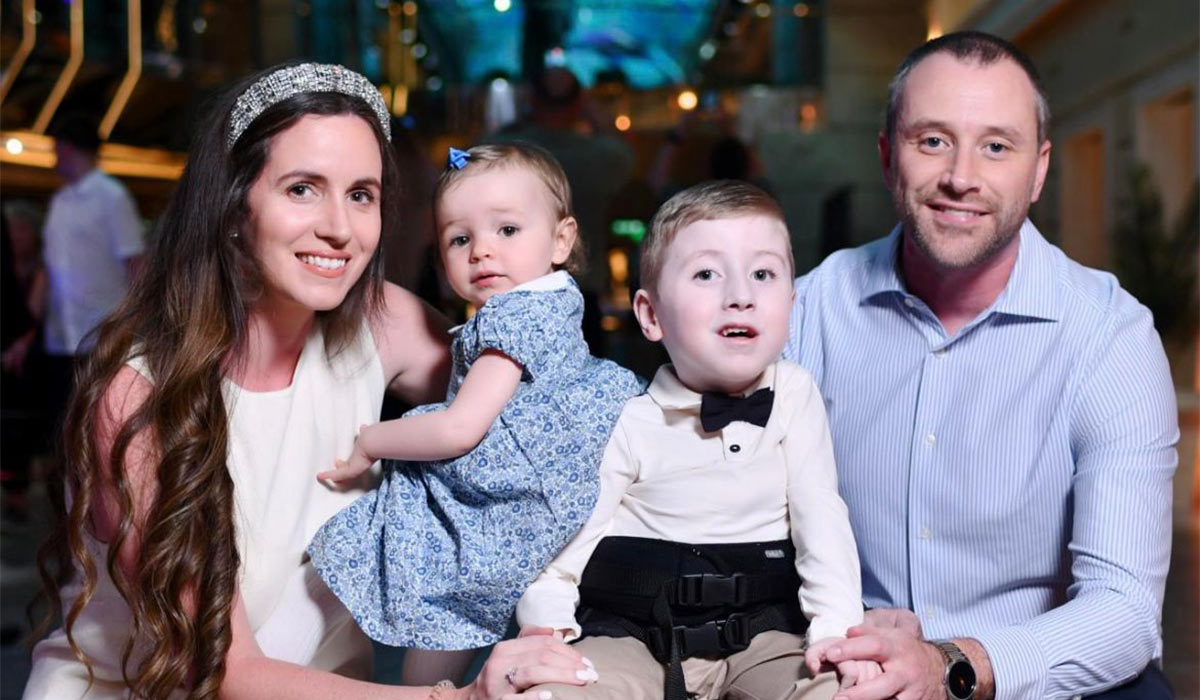
The roll-out of a new screening for babies to detect spinal muscular atrophy has been welcomed as a ‘life-changing’ development.
An estimated six babies each year in Ireland are born with spinal muscular atrophy (SMA), a rare genetic disease causing progressive muscle weakness and atrophy.
Screening for the disease was approved to be included in the heel-prick testing programme for five-day old babies in late 2023 but has been launched today after repeated delays.

Bróna Noonan’s four-year-old son Donnacha was diagnosed with SMA at 12 weeks old and the family have been advocating for the disease’s inclusion in the heel prick programme for years so that children like her son can get early treatment.
She told the Irish Daily Mail: ‘I would describe the screening as literally life-changing.
‘It’s the difference between your child walking or not, your child needing breathing support or not, your child needing a feeding tube or not, weekly speech and occupational therapy.’
The neurodegenerative disease is caused by the absence of the SMN1 gene which allows motor neurons to produce essential proteins to keep muscles working.

A one-time IV infusion before the age of two can deliver a functional copy of the gene to cells and significantly improve motor function.
Ms Noonan added: ‘The difference is that now SMA can be picked up straight away on the newborn screen, and they’ll start treatment in Temple Street straight away to be offered gene therapy, which is the closest thing to a miracle drug that halts the disease.’
Her son was treated with the gene therapy Zolgensma at four months old, just a month after his diagnosis, but the challenges of SMA still remain exceptionally hard.

A former HSE healthcare assistant, the mother of two is Donnacha’s full-time carer but hopes to return to work eventually.
She said: ‘If you had asked me a few years ago I would have said everything is fine, but as Donnacha gets older and is off to preschool he’s picking up bugs that are worse than your average child’s bugs.
‘Between 2024 and 2025 he was hospitalised almost every month and then he had to have major spinal surgery for his scoliosis, because it was really fast progressing.’

Ms Noonan and her husband Brian live in Edgeworthstown, Co. Longford, and had their second child, Síofra, last year.
She said: ‘She was automatically tested early on for SMA and was negative, but we were lucky, whereas another person, they’re not getting tested until there’s symptoms and then it’s too late.’
SMA will join Severe Combined Immunodeficiency (SCID) as part of the National Newborn Bloodspot Screening Programme expansion, bringing the number of conditions screened for in Ireland to 11.
SMA and SCID are both screened genetically, rather than metabolically, like the other nine conditions. This means that expanding the scheme required new equipment, training and personnel which pushed the delivery time significantly beyond the estimate of late 2024.

The Noonan family have been raising awareness with the voluntary group SMA Ireland to push for the faster progression of the screening programme. Ms Noonan said: ‘If anything, this could be a legacy for Donnacha.
‘He played a part in bringing this to the Government’s notice, bringing it to the forefront, and now that it is actually going to be implemented he is a part of that.
‘It’s bittersweet. We would have liked the early screening to have been there for us, but at the same time we couldn’t just lie back and not advocate for it because it wasn’t available for him.’
The Noonan’s home is just opposite the school that Donnacha attends for three hours of pre-school a day. However, there will be a host of added challenges in September when he progresses to primary school.
Ms Noonan said: ‘There will be a lot of changes for us and for staff because there’ll have to be a hoist put in and feeding regimens, because he doesn’t eat orally. He’s peg-fed.
‘There are those extra things that we won’t have to consider for our daughter, we can just pack a lunch for her and send her to school.’
The director of SMA Ireland, Jonathan O’Grady, also has the condition and told the Mail he believes Ireland has been slow to embrace new genetic testing.
He said: ‘Our group kept on the pressure for the roll-out of screening to begin we were hoping it would be done in a year.
‘After two years we were getting very frustrated but we just kept the pressure on and are delighted that at last it’s come to fruition.
‘It’s common for children born with SMA to go home with their parents thinking everything is fine until six, nine, maybe 12 months down the road when they start missing milestones and parents realise something is wrong.
‘Now they can be tested within days of being born and treated in weeks so it’s going to make a dramatic difference.
‘We’re already seeing in some Scandinavian countries where the children that have been treated early are walking and leading as normal a life as you could hope for.’
Ireland lags behind much of the rest of Europe when it comes to newborn heel prick screenings, where an EU average of 16 to 18 conditions are tested.
Mr O’Grady said he is hopeful the expansion will pave the way for more conditions to be added.